The Founder’s Mental Health Playbook: Beyond Burnout Culture
How the world’s most successful founders are rewriting the rules of entrepreneurial wellness—and why your mental health might be your startup’s most valuable asset.

The notification pings at 3:47 AM. Sarah, CEO of a promising fintech startup, reaches for her phone instinctively. Another “urgent” Slack message. Another fire to put out. She hasn’t slept more than four hours straight in weeks. Her co-founder quit last month, citing “unsustainable pressure.” Her best engineer just handed in her notice. Sarah tells herself this is just the price of building something extraordinary.
She’s wrong.
And she’s not alone.
In the mythology of Silicon Valley, burnout has been rebranded as dedication. Exhaustion masquerades as commitment. We’ve created a culture where founders wear their mental health struggles like badges of honor, where “I haven’t taken a day off in eight months” becomes a humble brag rather than a cry for help.
But here’s what the mythology doesn’t tell you: the most successful founders aren’t the ones who burn brightest—they’re the ones who burn longest.
The Hidden Cost of Founder Burnout
Recent studies reveal a sobering truth. Founders are 50% more likely to report mental health conditions than the general population. Depression rates among entrepreneurs are double the national average. Anxiety disorders affect 72% of founders at some point in their journey. Yet we continue to perpetuate the myth that suffering is not just necessary, but noble.
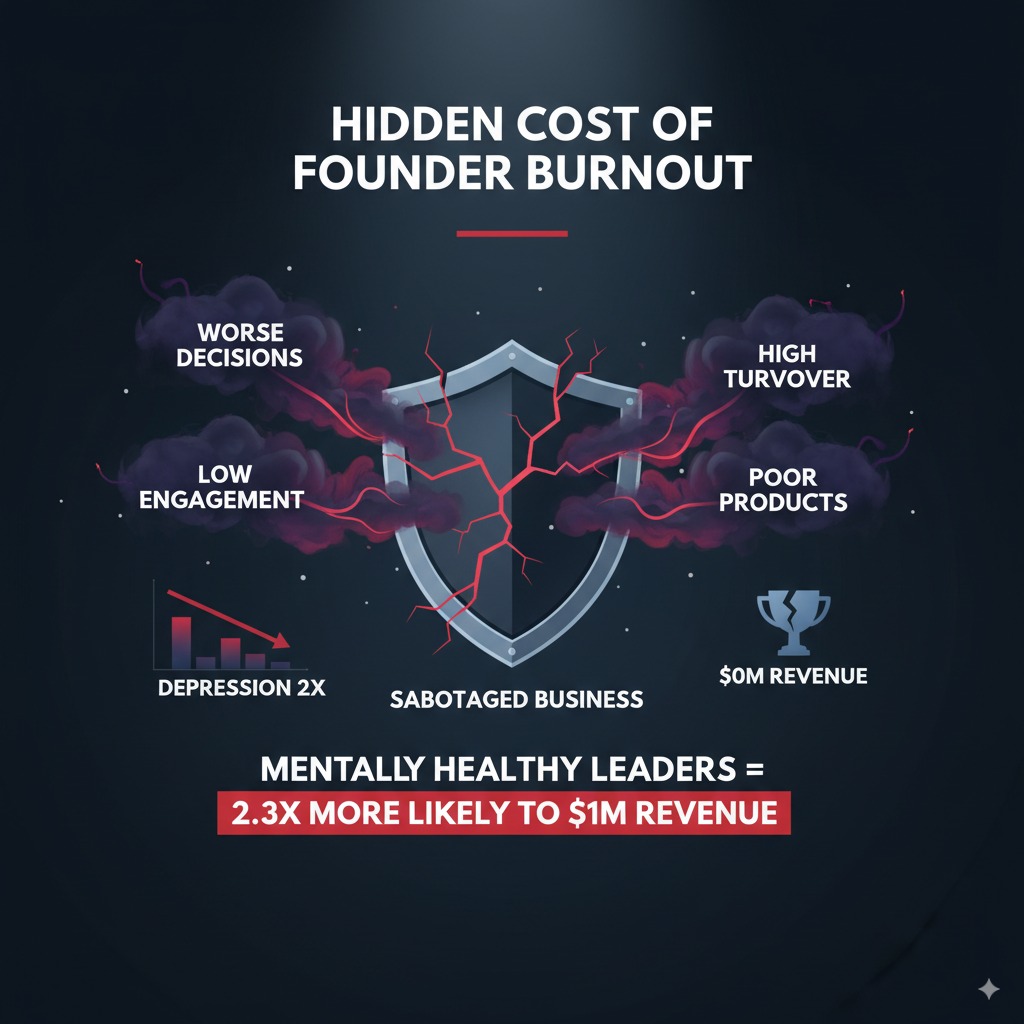
The real tragedy isn’t just personal—it’s strategic. Burned-out founders make worse decisions. They build worse products. They create worse cultures. They attract worse talent. The very thing they think will accelerate their success is actually sabotaging it.
Consider the data: Companies led by mentally healthy founders are 2.3 times more likely to reach their first $1M in revenue. Teams with mentally healthy leadership report 40% higher engagement scores. Investors are increasingly recognizing that founder wellness isn’t just a nice-to-have—it’s a fundamental business metric.
Your mental health isn’t separate from your business. It IS your business.
The Anatomy of Founder Mental Health

Before we can solve the problem, we need to understand it. Founder mental health challenges typically manifest across four interconnected dimensions:
1. The Pressure Dimension
- Identity Fusion: When your self-worth becomes inseparable from your startup’s success
- Imposter Syndrome: The persistent fear that you’re not qualified to lead
- Decision Fatigue: The exhaustion from making hundreds of decisions daily
- Resource Scarcity: The constant stress of limited time, money, and energy
2. The Isolation Dimension
- Lonely Leadership: The unique burden of being the final decision-maker
- Relationship Strain: How startup demands impact personal connections
- Network Gaps: Lack of peers who truly understand the founder journey
- Support System Erosion: Gradual loss of external emotional resources
3. The Control Dimension
- Uncertainty Intolerance: Struggling with the inherent unpredictability of startups
- Perfectionism Paralysis: When the need to be perfect prevents progress
- Micromanagement Tendencies: Difficulty delegating due to control fears
- Outcome Obsession: Focusing solely on results rather than process
4. The Identity Dimension
- Role Confusion: Unclear boundaries between personal and professional identity
- Value Misalignment: When business demands conflict with personal values
- Purpose Drift: Losing sight of original motivation and meaning
- Success Redefinition: Constantly moving goalposts for what constitutes “enough”
The Mental Health Playbook: A Systems Approach
Traditional approaches to founder mental health focus on individual resilience—meditation apps, therapy, exercise routines. These are valuable, but insufficient. Real founder wellness requires a systems approach that redesigns how you build and operate your company.
Strategy 1: Design for Sustainability from Day One

The Old Way: Sprint until you collapse, then recover The New Way: Build recovery and wellness into your operational DNA
Practical Implementation:
- Energy Audits: Track your energy levels like you track your burn rate. Identify what activities energize vs. drain you.
- Sustainable Scheduling: Block out non-negotiable time for rest, reflection, and relationships. Treat these as sacred as board meetings.
- Decision Frameworks: Create systems that reduce decision fatigue. Standardize recurring choices so your mental energy goes to what matters most.
- Boundary Architecture: Establish clear start and stop times. Your startup is a marathon, not a sprint.
At Good Peoples Ventures, we’ve seen founders transform their businesses by implementing “sustainable sprint cycles”—intense work periods followed by mandatory recovery phases. The result? Better decisions, more creativity, and ironically, faster progress.
Strategy 2: Build Your Mental Health Infrastructure
The Old Way: React to mental health crises as they arise The New Way: Proactively build systems that prevent crises
The Four Pillars of Mental Health Infrastructure:
1. Early Warning Systems Develop metrics that predict mental health challenges before they become crises:
- Sleep quality scores
- Stress response patterns
- Decision-making speed changes
- Relationship quality indicators
- Energy level fluctuations
2. Support Network Architecture Don’t leave your support system to chance. Actively design it:
- Peer Advisory Groups: Regular meetings with other founders at similar stages
- Professional Support Team: Therapist, coach, and medical professionals who understand startups
- Personal Board of Directors: 3-5 people who know you deeply and can provide honest feedback
- Accountability Partner: Someone who helps you stick to your wellness commitments
3. Cognitive Frameworks Mental models that help you process the emotional complexity of founding:
- The Long Game Perspective: Viewing temporary setbacks within a larger success timeline
- Process Over Outcome Focus: Measuring progress by effort and learning, not just results
- Systems Thinking: Understanding how your mental health impacts every aspect of your business
- Growth Mindset Application: Reframing challenges as development opportunities
4. Recovery Protocols Systematic approaches to bounce back from setbacks:
- Post-Crisis Analysis: Learning from mental health challenges without self-judgment
- Stress Recovery Routines: Proven methods for returning to baseline after high-stress periods
- Relationship Repair: Processes for mending relationships strained by startup pressure
- Meaning Reconnection: Regular practices that reconnect you with your deeper purpose
Strategy 3: Transform Your Company Culture
Your mental health and your team’s mental health are inseparable. The most mentally healthy founders create cultures that support everyone’s wellbeing.
Cultural Practices That Transform Mental Health:
Psychological Safety as Foundation
- Regular check-ins that go beyond work status
- Normalize conversations about stress and challenges
- Create space for vulnerability and authentic sharing
- Celebrate learning from failure, not just success
Autonomy with Alignment
- Clear vision and values that guide decision-making
- Trust team members to determine their own methods
- Regular feedback loops without micromanagement
- Ownership mentality throughout the organization
Growth-Oriented Environment
- Personal development budgets for every team member
- Learning time built into work schedules
- Mentorship programs and knowledge sharing
- Career pathing that extends beyond current roles
Human-First Policies
- Flexible work arrangements that respect personal needs
- Mental health days as standard policy
- Family and personal crisis support systems
- Sabbatical opportunities for long-term team members
Strategy 4: Redefine Success Metrics
The metrics you track shape your behavior. Most founders track financial metrics obsessively but ignore the leading indicators of sustainable success.
Balanced Scorecard for Founders:
Financial Health (25%)
- Revenue growth
- Burn rate management
- Fundraising milestones
- Unit economics
Mental Health (25%)
- Energy levels
- Sleep quality
- Stress management
- Relationship satisfaction
Team Health (25%)
- Employee engagement scores
- Retention rates
- Performance growth
- Cultural alignment
Strategic Health (25%)
- Vision clarity
- Market positioning
- Competitive advantage
- Future preparedness
By giving equal weight to these four areas, you create a more holistic definition of success that actually predicts long-term business outcomes.
The Neuroscience of Founder Resilience
Understanding how your brain responds to the unique stresses of founding can help you work with your neurology, not against it.
The Founder’s Brain Under Stress:
When founders operate in chronic stress mode, three key brain changes occur:
- Amygdala Hijack: Your threat-detection system becomes hyperactive, leading to reactive rather than strategic decision-making
- Prefrontal Cortex Impairment: Your executive function diminishes, affecting planning, creativity, and complex reasoning
- Hippocampus Disruption: Your memory formation and pattern recognition decline, making it harder to learn from experience
Neuroplasticity-Based Interventions:
Mindfulness for Executive Function Regular meditation doesn’t just reduce stress—it literally rewires your brain for better decision-making. Studies show that founders who practice mindfulness have increased prefrontal cortex activity and better emotional regulation.
Physical Exercise for Neurogenesis Cardiovascular exercise promotes the growth of new brain cells, particularly in areas responsible for learning and memory. Founders who maintain consistent exercise routines show improved problem-solving abilities and stress resilience.
Sleep Optimization for Memory Consolidation Sleep isn’t downtime—it’s when your brain processes information, forms memories, and generates insights. Founders who prioritize sleep quality report more creative solutions and better strategic thinking.
Social Connection for Stress Buffering Strong relationships activate your brain’s stress-buffering systems. Founders with robust social support networks show lower cortisol levels and better immune function.
The Integration Challenge: Making It Practical
The biggest challenge isn’t knowing what to do—it’s integrating these practices into the chaotic reality of building a startup. Here’s how to make it work:
The 1% Rule
Rather than attempting massive changes, commit to improving your mental health systems by 1% each week. Small, consistent improvements compound into transformative change.
The Integration Method
Don’t add new practices—integrate them into existing routines:
- Turn commute time into reflection time
- Transform team meetings into connection opportunities
- Use exercise time for strategic thinking
- Make meals into mindfulness practice
The Accountability System
Create external accountability for your mental health commitments:
- Share your wellness goals with your co-founder or leadership team
- Regular check-ins with a coach or therapist
- Peer accountability groups with other founders
- Public commitments that create positive pressure
The Business Case for Founder Mental Health
Let’s be clear: this isn’t just about feeling better. It’s about building better businesses.
Companies with mentally healthy founders demonstrate:
- 23% higher profitability
- 18% higher productivity
- 12% better customer metrics
- 40% lower turnover
- 225% better stock price performance
The ROI of Mental Health Investment: For every dollar invested in founder mental health support, companies see an average return of $4 in increased productivity, reduced turnover, and improved decision-making quality.
Investor Perspective: Top-tier VCs are increasingly evaluating founder mental health as a key investment criterion. They understand that sustainable founders build sustainable businesses.
Beyond Individual Solutions: The Ecosystem Approach
Individual founder mental health improvements are necessary but insufficient. We need systemic change in how the startup ecosystem operates.
What Good Peoples Ventures Is Doing Differently:
Holistic Founder Support We don’t just provide capital—we provide comprehensive support systems that include mental health coaching, peer networks, and wellness resources as standard parts of our partnership.
Long-Term Relationship Design Our relationships with founders extend beyond traditional investment timelines. We’re committed to supporting founder wellness throughout their entire entrepreneurial journey.
Cultural Leadership We’re actively working to change the narrative around founder mental health, demonstrating that sustainable practices lead to better business outcomes.
Educational Infrastructure We provide ongoing education and resources that help founders build mental health literacy and develop sustainable practices.
The Future of Entrepreneurship
We’re at an inflection point. The old model of entrepreneurship—characterized by unsustainable pressure, cultural glorification of burnout, and individual heroics—is breaking down. The founders and companies that will thrive in the next decade will be those that embrace a more holistic, sustainable approach.
This isn’t about lowering standards or reducing ambition. It’s about channeling that ambition in ways that create lasting value rather than burning out the very people creating that value.
The New Entrepreneurial Paradigm:
- Sustainable Intensity: High performance sustained over time, not brief bursts followed by crashes
- Collective Success: Building teams and communities that amplify individual capabilities
- Holistic Metrics: Success measured across multiple dimensions, not just financial outcomes
- Regenerative Practices: Business practices that restore and replenish rather than just extract and consume
Your Next Steps
If you’re a founder reading this and recognizing yourself in these words, here’s how to begin:
Week 1: Assessment
- Complete a comprehensive mental health and energy audit
- Identify your primary stress patterns and triggers
- Assess your current support systems and infrastructure
Week 2: Design
- Choose one area from the playbook to focus on first
- Design specific, measurable practices you can implement immediately
- Create accountability systems to support your commitment
Week 3: Implementation
- Begin implementing your chosen practices consistently
- Track your progress using both quantitative and qualitative measures
- Adjust and refine based on initial results
Week 4: Integration
- Integrate successful practices into your standard operating procedures
- Share your learning with your team and begin cultural transformation
- Plan for the next area of focus
The Invitation
At Good Peoples Ventures, we believe that the future belongs to founders who understand that their mental health isn’t separate from their business strategy—it IS their business strategy. We’re not just investors; we’re partners in building sustainable, successful, and deeply human companies.
If you’re a founder who’s tired of choosing between success and sanity, who believes that great businesses can be built without sacrificing your humanity, who’s ready to embrace a more sustainable and ultimately more successful approach to entrepreneurship—we want to talk with you.
And if you’re a talented professional who’s passionate about supporting founders in this journey, who wants to be part of redefining what venture capital can be, who believes that business can be a force for human flourishing—we want you on our team.
The old table is broken. The new one awaits.
Will you help us build it?
Ready to transform your approach to founder mental health? Connect with Good Peoples Ventures at brandon@goodpeoplesventures.com or learn more about our unique approach to supporting founders at goodpeoplesventures.com.
For team members passionate about revolutionizing venture capital through human-centered practices, explore our open positions and join our mission to prove that businesses can be both wildly successful and deeply humane.